Friday, 14 December 2012

Aisha Khalid Exhibit - Whitworth Gallery

This exhibition was interesting as part of it was done on site. Embroidered roses up the wall of the whitworth were a mix between hand and machine techniques, and they worked really well; the scale of the design made it stand out and the accompanying video showing how individual roses were made was nice to see. The colours used were well selected, with bold red, black, green and gold standing out.

'Larger than Life' from www.whitworth.manchester.ac.uk
Writing them in a list here has made me realise that these are traditional Christmas colours, though these pieces had a totally different feel to them, because of their combinations and usage in pattern, let alone the subject matter of a post 9/11 world.

Although the subject matter is important and has depth, when observing the art I judged and enjoyed it visually; the fact that there was a subject behind it didn't matter to me, though it did make the work feel less playful when seen in context. Now when I see the pieces, instead of folded fabric or old style theatre curtains I see the bottom of a burqa, and the connotations of female oppression and political clashing that accompany it. I think I would have preferred not to know why these pieces were created, perhaps because art is an escape from politics and reality for me; the world is so far from being an acceptable place to live that an unexpected reminder of this makes the situation seem even more bleak.

Interestingly, when I cover the bottom section of this piece, and can only see the pattern with no form, it has none of these connotations and just feels better to look at. This is definately a form of denial, an effort to ignore problems, but if we thought about all the injustice in the world we would never get out of bed in the morning. Much better to keep yourself busy, to loosely quote The Hitchhiker's Guide to the Galaxy. This is a selfish viewpoint, but a necessary one for me; I design, draw and make things because it makes me happy and I feel productive doing it rather than to broadcast a message to the world. There's enough despair without adding to it, and my cynical side says that people who don't consider world affairs important are unlikely to have a revelation because they see one piece of art.

Having said all of that, I admire Aisha Khalid for being open enough to share her personal experiences and views, and maybe if enough people did that, real change could happen, and my narrower view of what art 'should' be could become ridiculous.

Monday, 10 December 2012

BBC Blitz map

I found this map on the BBC News website on the 7th December, showing the distribution of approximately 30,000 bombs during the Blitz of London in WWII between October 1940 and June 1941. It was the result of a project called 'Bomb Site' by a team from the University of Portsmouth using data from the National Archives. The circular nature of the points of the map reminded me of the people in the Hub that I used as data for my 'graph', and I could maybe include information about each person in my work somehow, whether it be the colour of their clothes or their height or a distinguishing feature.


Oblique Strategies

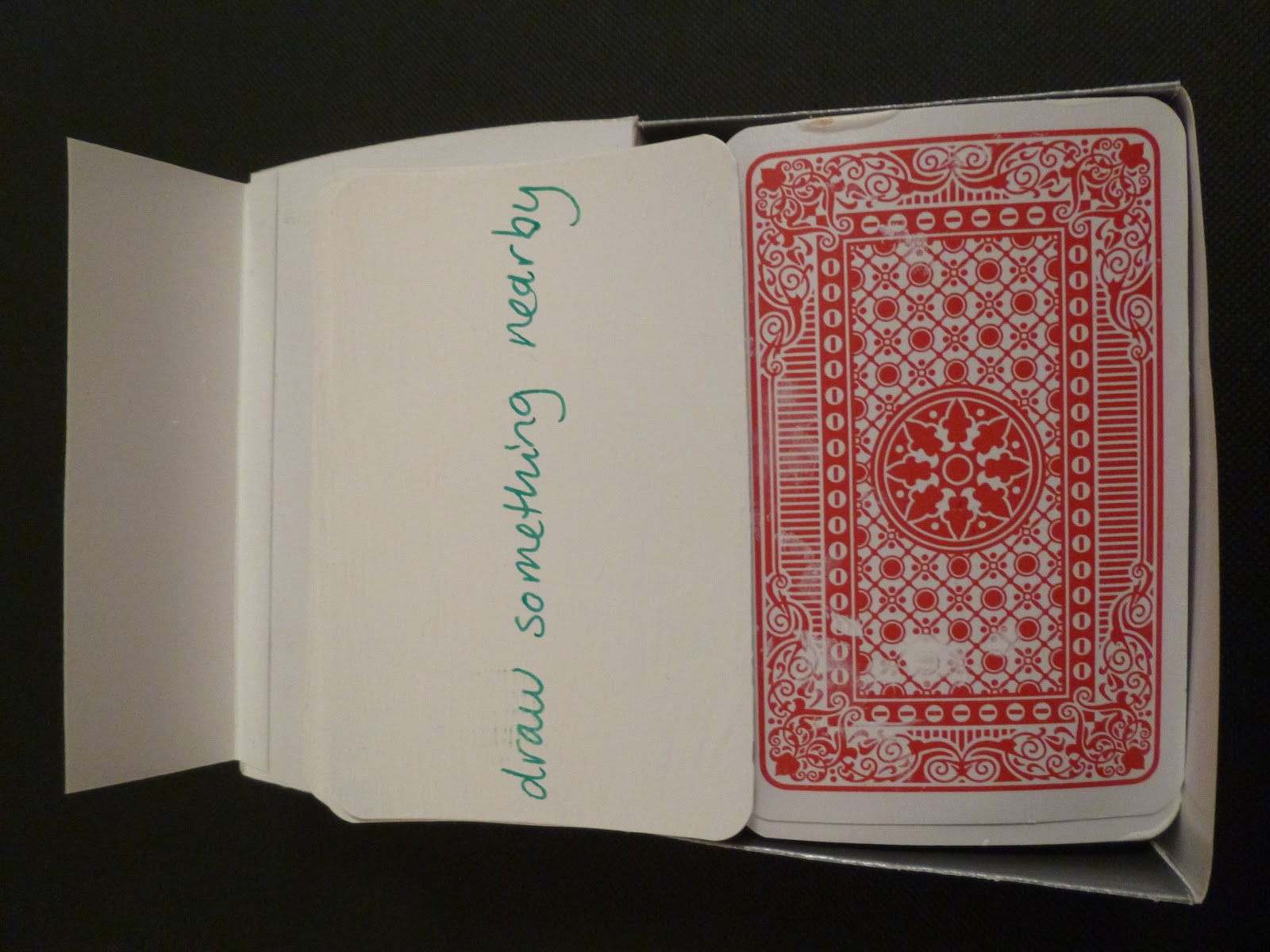
At the end of the Origins Unit, Kate recommended that I should look at Brian Eno and Peter Schmidt's 'Oblique Strategies', a deck of cards from 1975 that they used when stuck or producing unoriginal work to stimulate their creativity. They had some really good ideas, so I decided to make my own deck, by whitewashing some playing cards and tailoring phrases to art rather than music, and coming up with some of my own phrases. I made a box for them, so I can carry them with me and use them when I need shaking up or just for inspiration.


Data Project Drawing


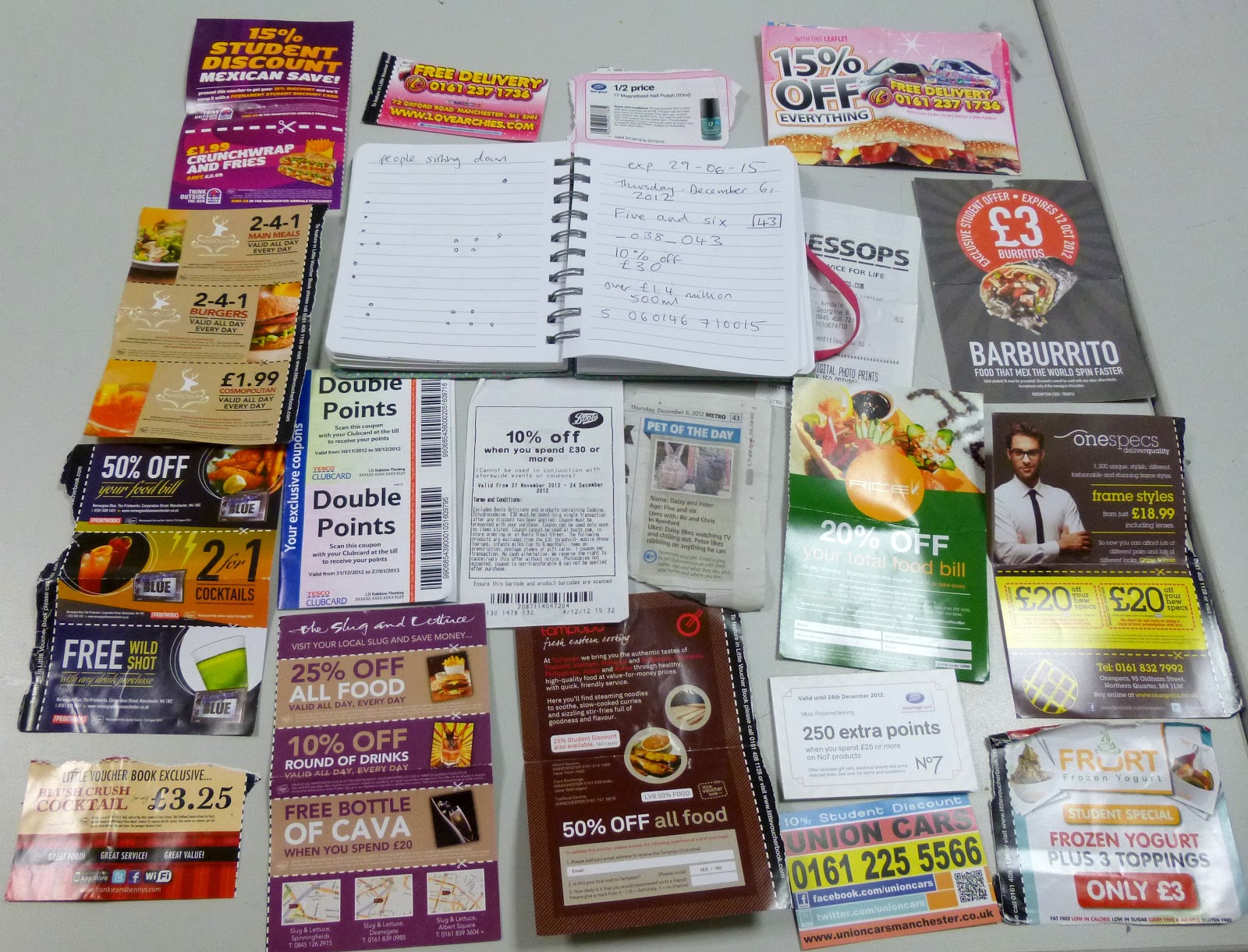
We got our next task via a chinese whispers line; the message I received was 'collect graphs numbers and grids'. So I used vouchers from my purse and made my own 'graph' of people sitting at tables in the Hub. The tables themselves form a grid or graph lines, and the people became points on this graph.


Books were provided for us to look through for inspiration, and I found some pictures of grid-like forms, such as a chair by Charles Rennie Mackintosh, and circular images such as dandelion clock flowers to demonstrate less bold ways to represent people. In the afternoon we started drawing from this research, and I thought the self-made graphs had the most potential to make interesting marks, so I focussed on them. We were asked to work with wet media, and I chose ink and water to start with. 


Left: grid made from masking tape, ink and graphite pencil. Right: pipette marks forming 'people'


Stencil based on Charles Rennie Mackintosh's chair, and putting ink through the stencil using grid-like lines of text as a base, with ink blob 'people'. These work quite well as the structure is emphasised while the marks themselves remain fluid and inexact.

Using a toothbrush i started flicking ink through the stencil to give a sprayed effect that still has structure to it, and then directly used the toothbrush to make 'table' marks before pipetting ink onto them to form the 'people'.


When experimenting with the ink, I noticed that air in the pipette would form bubbles, which would burst, spraying ink out from the centre and making interesting marks.The bubbles themselves have a special quality about them, and like the people in the Hub are transient.


I enjoyed making marks in this way, as it forced me not to think too much about literal translation, instead focussing on marks and shapes. I think there is something in the idea of gathering my own data, instead of using someone else's. It will definitely produce a personal response and means I will always have something new and current to base my research on. I liked the fact that the people in the Hub would move around, so just by staying in one location I captured several moments of fleeting data, and showed the use of the space.

Data Drawing Day

We were set 3 tasks, to help us broaden our experience of drawing. The first involved trying to draw 200 concentric rings less than 3mm apart in 30 minutes with a pencil with our non-dominant hand. The second was to repeat this with charcoal at the end of a stick. I enjoyed the first task more, as I felt that I had more control over the lines, could tell I was improving as time went on (though towards the end became more reckless!) and liked the end result. The charcoal was a bit more unpredictable, but not enough to make interesting unexpected marks. Alice had a very bendy stick, and that made some really great marks, so that might be worth trying in the future.

pencil above charcoal below


The third task was to use some of the drawing techniques such as setting rules for drawing to depict: instructions for how to get out of a maze. The first thing that entered my head was the practical solution 'put one hand against the wall and walk' - this is guaranteed to work with all traditional mazes, though it isn't the most efficient way. Using text I drew a symbol that represents an extended arm and 2 feet, with a 2B pencil, again in 30 minutes. To make it more interesting I started quite carefully and slowly, and progressively increased my writing speed, mimicking the increased sense of panic you feel if trapped in a maze. This produced good results, and turned legible text into marks.

close up of frantic text
route out of the maze


Friday, 30 November 2012

Evaluation of the Origins Unit


Over the course of this unit I have learned a lot about the way I work as a designer/maker. Machine embroidery was almost completely new to me, but the samples I produced were really successful, in part because I didn’t use unnecessary steps in making pieces and had a quick turnover of ideas. Working straight from images or photos to material suited me well.

layered lace machine sample

When it came to drawing for Journeys, I was happy with the representational style I used but could have branched out further into mark making to broaden my research. 

bicycle in manchester; could be a good source for mark-making

When hand stitching I retained this literal approach but it didn’t work as well as the partial or abstract translation used with my machine sampling. I felt that I should draw it, transfer it into stitch and then develop it, when I should have been confident that ‘skipping’ steps could still produce good work. Reflecting more often and taking more risks should help to make my work more interesting and save valuable time. To help with this I aim to make myself a set of cards to be chosen at random when I feel stuck or too ‘safe’ to help shake things up by introducing an element of surprise.

Only when looking back did I realise the main theme for the project was ‘grids’; if I had noticed this sooner I could have played around with the form more, exaggerated it and developed it further. 

grid-like images from liverpool, manchester, and the construction day and a grid-like woven paper background 


Also I could have thought more laterally about what a grid is and what it represents to develop a contemporary interpretation of it. I tend to feel comfortable working to a small scale but it would be good to push myself to make larger pieces of work.

I generally find looking at other people’s work inspiring or at the very least an example of what not to do, so I should have gone to more exhibitions during the block to help further shape my work. The pieces I did see helped me to see the value of limiting colour and material usage, while the contextual studies unit reminded me of the importance of re-using materials, and finding the balance between fast and slow ways of working to make interesting, personal pieces.

This block has been challenging because it chopped and changed a lot; I felt that various mini projects and different technical skills were distracting me from the Journeys project which was frustrating. However I eventually realised that this is how it will be as a designer in the ‘real’ world; often many different things will demand my attention so it is worth learning to adapt now to this way of working. Also, if anything using different skills will push my work forward in a new way, and sticking to a plan might not always be the best way of making.

Friday, 23 November 2012

Personal Reflection Notes on Origins and Journeys


Overall I feel that I've learned a lot about the way I work that I wouldn't have found out otherwise, for example in machine I was comfortable translating images from photographs directly into material samples with no intermediate drawing stage. I also really liked the immediacy of machine stitch and the range of effects and drawn quality you can get with the machine work which I didn't expect. I was really happy with the final batch of machine samples I produced, the choice of materials and layering effects worked well. With practice the level of finish could be improved, and I could incorporate new materials.

My initial drawing style was representational, as I enjoy mark making in that way, but I was too slow to translate that into more abstract patterns or marks when it came to hand stitching. I felt that I should draw representationally with stitch, and it didn't work as well as I thought it would; I need to find a style that emphasises the texture and feel of wool and thread and the feel of the images while being more free with mark making, as I was with machine. Also I would like to practice combining different combinations of drawings, prints, photos/images, materials and threads; I think this will be a challenging process and take time to get right, but would be worth the time spent as it would make more interesting pieces.

The construct day was really fun, and wish I had had more time to go back and draw from the samples I made; putting them together created interesting patterns and made it easier to imagine my images being re-created on a larger scale. Also if the material links to the project, as the Shreddies did with Journeys, then it could be incorporated into a 3D piece, which again sounds exciting.


Looking back, I feel that I could have been more motivated through these projects. I really got stuck in to the Journeys project from the start, but when we started working with machine embroidery I felt like that project had to be put on hold, because of time constraints, and because we were doing something new the Journeys project was no longer my focus. I did try to incorporate images from Journeys into machine work, and felt like in the last week things were clicking into place. However, we were then moved on to hand stitch, so again my focus again had to shift to something new. There was more time available in this unit to carry on with Journeys, but I still felt divided, and wanted to focus more.


I found it difficult working without knowing what was going to be happening the next day or next week; I am usually very organised so found it difficult not being able to properly plan what I could do at home or what materials to bring for a day in the studio. It was also hard to work without a set end point; knowing that I wasn't working towards a final piece meant that my research kept cycling around, and going off in different directions; this wasn't helped by moving from drawing to machine to stitch. I just wanted to get my teeth into the Journeys project, and I only felt that that happened at 2 points; at the end of the first 2 weeks of drawing and at the end of hand stitch.


I think I got frustrated with the set up partially because it was not what I expected; I was given the impression from open days that on the degree you are left to get on with it yourself, and you sign up for workshops and tutorials separately. I thought that we would have one project that would last all term, and when we did workshops we would use images from Journeys to work from. I didn't react well to being told so explicitly what to do for so long, and felt like I was being distracted from the initial project we had been set, which I had really enjoyed.

Next time this occurs I will try to realise what's happening, be more flexible in my approach and try not to get frustrated; we need technical workshops to learn the skills, and sometimes the set projects are really helpful, for example in machine most things were new to me, so working in black and white meant I didn't have to split my focus too much in that area.

Hopefully, when I start the Print unit I will have a better idea of what to expect, which will help me to slot in to the right way of working more quickly. I think that it will still feel like we are chopping and changing what we are doing too quickly, but speaking to people in print and seeing their work has given me a better idea of what will happen over the whole block.